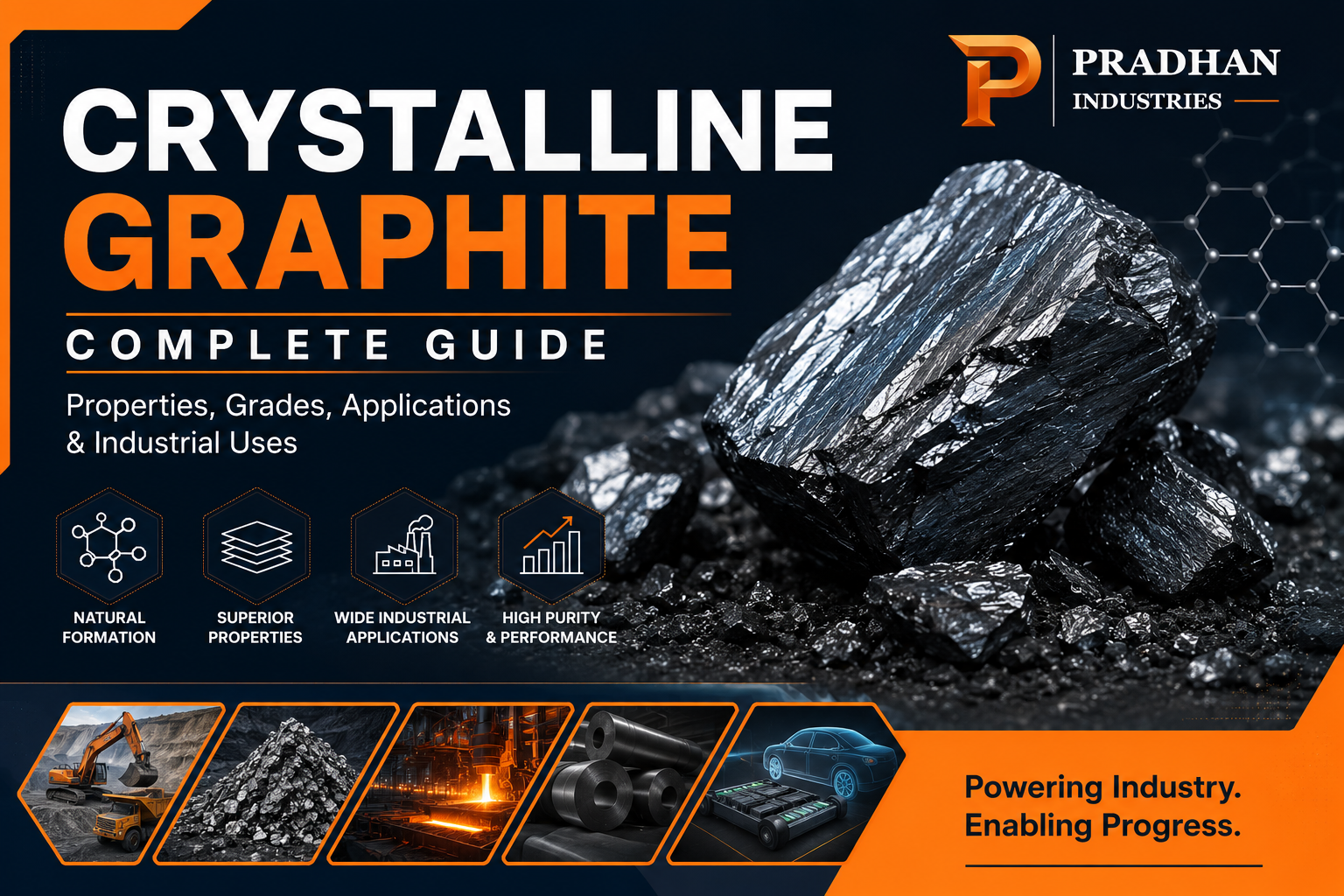
Crystalline graphite is nature’s most refined form of carbon — a mineral where carbon atoms have arranged themselves into orderly, layered crystals over millions of years. That crystal order is exactly what industry pays for. It gives graphite its conductivity, heat resistance, and lubricity, and it is why demand keeps climbing across EV batteries, steel, refractories, lubricants, foundries, and renewable energy.
If you are a buyer, engineer, or procurement manager evaluating graphite grades, this guide covers everything you need: how crystalline graphite forms, the types and grades available, its properties, how it is processed, and how to choose a supplier you can rely on. It is written by Pradhan Industries, a natural graphite manufacturer that mines, processes, and tests this material every day.
What is Crystalline Graphite?
Crystalline graphite is a naturally occurring form of carbon in which the atoms are arranged in well-ordered, layered hexagonal crystals. Each layer is a flat sheet of carbon rings; the sheets stack on top of one another and slide easily, which is why graphite feels slippery and marks paper.
This visible crystal structure is what separates crystalline graphite from amorphous graphite. Amorphous graphite (technically microcrystalline) has crystals so small they cannot be seen, lower carbon content, and weaker performance. Crystalline graphite — especially flake and vein varieties — offers higher purity, better conductivity, and superior heat resistance, which is why it commands the premium end of the market.
In simple terms: the bigger and more ordered the crystals, the better the graphite performs — and the more it is worth.
How is Crystalline Graphite Formed?
Crystalline graphite is a metamorphic mineral. Its story starts with carbon-rich sediments — ancient organic matter buried in sea beds and swamps hundreds of millions of years ago.
As tectonic movement buried these deposits deeper, two forces went to work:
- Heat — typically above 750°C deep in the earth’s crust
- Pressure — from kilometres of overlying rock
Over geological time, this heat and pressure stripped away hydrogen, oxygen, and other elements, and forced the remaining carbon atoms to reorganize into ordered crystal layers. The host rocks — usually marble, schist, and gneiss — still carry graphite deposits today. Britannica’s entry on graphite covers this metamorphic origin in more detail.
The degree of metamorphism decides the crystal size. Intense, prolonged metamorphism produces large flakes and veins; milder conditions produce fine or microcrystalline material. No factory can replicate this process economically — synthetic graphite made at ~3,000°C still struggles to match the crystal perfection nature achieved for free.
Types of Crystalline Graphite
Not all crystalline graphite is the same. Buyers should know these five commercial categories:
Large flake graphite (+80 mesh): The premium natural grade. Large, visible flakes with high carbon content, prized for expandable graphite, foils, and high-end refractories.
Medium flake graphite (+100 to +150 mesh): The workhorse for refractories, crucibles, and brake linings — a balance of performance and cost.
Fine flake graphite (-100 to -200 mesh): Used for battery anodes (after spheronization), lubricants, coatings, and pencils.
Microcrystalline (amorphous) graphite: Very fine crystals, 70–85% carbon, used where cost matters more than purity — foundry facings, some lubricants, and steel recarburizing.
Vein (lump) graphite: The rarest form, found mainly in Sri Lanka. Extremely high in-situ purity (90–99%) but limited supply keeps it a specialty product.
| Type | Typical Carbon % | Flake/Crystal Size | Relative Price | Best For |
|---|---|---|---|---|
| Large flake | 94–97% (99%+ after purification) | > 180 µm | High | Expandable graphite, foils, premium refractories |
| Medium flake | 90–96% | 100–180 µm | Medium-high | Refractories, crucibles, friction materials |
| Fine flake | 85–95% | < 100 µm | Medium | Battery anodes, lubricants, coatings |
| Microcrystalline | 70–85% | < 40 µm | Low | Foundry facings, recarburizer, budget lubricants |
| Vein (lump) | 90–99% | Variable | Very high | Specialty carbon products, brushes |
Physical and Chemical Properties of Crystalline Graphite
| Property | Value / Behaviour |
|---|---|
| Carbon content | 85–99.9% depending on grade and processing |
| Crystal structure | Hexagonal, layered (sp² bonded carbon sheets) |
| Density | 2.09–2.26 g/cm³ |
| Hardness | 1–2 on Mohs scale (very soft, marks easily) |
| Melting behaviour | Sublimates around 3,600°C; usable to ~2,500°C in inert atmosphere |
| Electrical conductivity | High along crystal layers (~10⁴–10⁵ S/m) — rare for a non-metal |
| Thermal conductivity | 25–470 W/m·K; excellent heat spreading and shock resistance |
| Lubrication | Self-lubricating; layers shear easily under load |
| Chemical resistance | Inert to most acids, alkalis, and solvents; oxidizes in air above ~450°C |
Chemically, graphite is pure elemental carbon — the same composition documented in PubChem’s graphite record. Its unusual behaviour comes entirely from the crystal arrangement, including its extremely high melting point, among the highest of any material.
Benefits of Crystalline Graphite
Why do buyers specify crystalline grades even at higher cost? Seven practical reasons:
- High purity potential. Flake graphite beneficiates and purifies well, reaching 99%+ carbon for demanding uses.
- Excellent electrical conductivity. One of the only non-metals that conducts, making it essential for batteries, electrodes, and brushes.
- Outstanding heat resistance. Performs where metals melt and plastics burn.
- Chemical stability. Survives molten metal, acids, and corrosive process environments.
- Natural lubrication. Reduces friction dry, with no oil needed — even at high temperatures.
- Long service life. Crucibles, refractories, and components made with crystalline graphite simply last longer between replacements.
- Consistency. Well-processed crystalline grades hold tight specifications lot after lot, which keeps downstream processes stable.
Industrial Applications of Crystalline Graphite
The list of industrial graphite uses keeps growing. Here are the sectors that consume the most crystalline material today.
Lithium-Ion Batteries
Battery-grade graphite is now the largest growth driver for the industry. Fine flake graphite is shaped into spherical particles and coated to make anodes that store lithium ions between the crystal layers. The International Energy Agency lists graphite among the critical minerals for the energy transition — a typical EV battery holds 50–70 kg of it, more than lithium and cobalt combined.
Steel Manufacturing
Steel plants use crystalline graphite powder as a recarburizer to adjust carbon content in molten steel, and graphite-bearing refractories line the vessels that hold the melt.
Foundries
Foundries apply graphite as mould facings and coatings so castings release cleanly with smooth surfaces, and rely on graphite crucibles for melting non-ferrous metals.
Refractories
Magnesia-carbon bricks, ladle linings, stopper rods, and continuous-casting components all depend on flake graphite for thermal shock resistance and slag resistance. This remains one of the largest end-uses worldwide, per USGS graphite statistics.
Friction Materials and Lubricants
Brake linings and clutch facings use graphite to manage heat and friction. Dry lubricants, greases, and forging release agents exploit its self-lubricating layers where oils fail.
Expandable Graphite and Flame Retardants
Treated large flakes expand up to hundreds of times their volume when heated — the basis of graphite foils, seals, and fire-retardant building materials.
Everyday and Specialty Uses
Pencils blend fine graphite with clay. Carbon brushes carry current in motors. Fuel-cell bipolar plates, conductive coatings, electronics heat spreaders, semiconductor crucibles, and nuclear reactor moderators (which require ultra-high-purity graphite) round out a remarkably diverse demand base.
| Industry | Application | Preferred Grade |
|---|---|---|
| Batteries / EV | Anode material | Fine flake, 99%+ purified |
| Steel | Recarburizer, refractories | Medium/fine flake, 90–97% |
| Foundry | Mould facings, crucibles | Fine flake / microcrystalline |
| Refractory | MgO-C bricks, ladle linings | Medium/large flake, 94–97% |
| Friction | Brake linings | Fine/medium flake |
| Lubricants | Dry lubricants, greases | Fine flake / microcrystalline |
| Fire safety | Expandable graphite | Large flake, 94%+ |
| Electronics | Heat spreaders, brushes | High purity flake |
Crystalline Graphite vs Amorphous Graphite
| Parameter | Crystalline (Flake/Vein) Graphite | Amorphous (Microcrystalline) Graphite |
|---|---|---|
| Crystal size | Large, visible flakes or veins | Microscopic crystals |
| Typical carbon content | 85–99%+ | 70–85% |
| Electrical conductivity | High | Moderate to low |
| Thermal performance | Excellent | Fair |
| Lubricity | Excellent | Good |
| Purification potential | Excellent (to 99.9%) | Limited |
| Price | Higher | Lower |
| Typical uses | Batteries, refractories, expandable graphite, electronics | Foundry facings, recarburizer, budget lubricants |
The simple rule: if your application depends on conductivity, heat performance, or purity, specify crystalline. If it only needs carbon content at the lowest cost, amorphous may do the job.
How Crystalline Graphite is Processed
Understanding processing helps buyers ask better questions. Here is the journey from ore to shipped product:
- Mining. Graphite ore is extracted from open-pit or underground deposits, typically containing 5–20% graphite.
- Crushing. Ore is broken down to liberate graphite flakes from the host rock.
- Grinding. Careful, staged grinding frees more graphite while protecting flake size — over-grinding destroys value.
- Flotation. Graphite’s natural water-repellence lets it float on air bubbles while waste rock sinks. Multiple flotation stages raise carbon content to 85–97%.
- Drying. Concentrate is dried to strict moisture limits, usually below 0.5%.
- Classification. Screening separates the product into precise mesh sizes for different applications.
- Quality control. Each batch is tested for fixed carbon, ash, moisture, volatile matter, and particle size distribution.
- Packaging. Material is packed in moisture-protected bags or bulk containers, labelled by grade and lot for full traceability.
For 99%+ battery and specialty grades, additional chemical or thermal purification removes the final impurities.
How to Choose the Right Crystalline Graphite Supplier
A good specification means nothing if your supplier cannot hold it. Use this checklist:
- Verify fixed carbon claims. Ask for batch-wise certificates of analysis, not brochure numbers.
- Check ash and moisture data. Low ash means fewer conductive and refractory problems; moisture under 0.5% protects your process.
- Confirm mesh size range and particle distribution reports. A nominal mesh number hides a lot — the distribution curve tells the truth.
- Ask about lot-to-lot consistency. Request CoAs from several past shipments and compare them.
- Assess supply capacity. Can the supplier hold specs at your annual volume, not just for a sample?
- Review export experience. Documentation, packaging, and logistics discipline matter for international buyers — an established graphite exporter removes friction at customs.
- Test their technical support. A capable graphite supplier in India or anywhere else should help you select the grade, not just quote a price.
- Start with a qualification sample, then a trial lot, before committing to volume.
Why Choose Pradhan Industries?
Pradhan Industries supplies natural crystalline graphite to buyers across the battery, steel, refractory, foundry, friction, and lubricant industries in India and abroad. What sets our supply apart:
- High-purity natural crystalline graphite in flake and powder forms, with fixed carbon grades from standard to 99%+
- Modern processing — staged grinding and multi-stage flotation designed to protect flake size and maximize purity
- Batch-wise laboratory testing with full certificates covering carbon, ash, moisture, and particle size distribution
- Custom grades and mesh sizes matched to your application instead of forcing a standard product
- Reliable bulk supply and logistics, including export documentation and packaging for international shipments
- An experienced technical team that helps you specify correctly before you order
We treat the first conversation as technical consultation, not a sales call. Getting the grade right the first time saves both sides money — and that is how we keep customers for years.
Frequently Asked Questions About Crystalline Graphite
What is crystalline graphite used for?
Crystalline graphite serves lithium-ion battery anodes, steel recarburizing, refractories, foundry coatings, crucibles, brake linings, lubricants, expandable graphite, carbon brushes, pencils, and electronics. Its combination of conductivity, heat resistance, and lubricity makes it irreplaceable in applications where metals, plastics, or ceramics fail.
What is the difference between crystalline and amorphous graphite?
Crystalline graphite has large, visible, well-ordered crystals with 85–99%+ carbon, giving superior conductivity and heat performance. Amorphous graphite has microscopic crystals and 70–85% carbon. Crystalline grades cost more but purify better and perform far better in demanding applications like batteries and refractories.
Is crystalline graphite natural or synthetic?
The term usually refers to natural graphite — flake, vein, and microcrystalline forms created by geological heat and pressure over millions of years. Synthetic graphite is also crystalline but is manufactured from petroleum coke at around 3,000°C, which makes it significantly more expensive and energy-intensive.
How pure is crystalline graphite?
Run-of-mine ore contains 5–20% graphite. Flotation raises this to 85–97% fixed carbon. Additional chemical or thermal purification produces 99–99.9% grades required for batteries, semiconductors, and nuclear applications. Always confirm purity with a batch certificate rather than relying on nominal grade names.
Why is flake size important?
Larger flakes carry higher prices because they perform better and cannot be manufactured — only mined. Large flakes are essential for expandable graphite and foils, deliver better conductivity in compacts, and purify more easily. Once a flake is broken during processing, its value is permanently lost.
Which graphite is used in EV batteries?
Battery anodes use fine flake natural graphite that is purified to 99.9%+, shaped into spherical particles, and surface-coated — or synthetic graphite. Natural graphite’s lower cost and smaller carbon footprint are driving more battery makers toward natural crystalline material.
Can crystalline graphite withstand high temperatures?
Yes. Graphite does not melt at atmospheric pressure; it sublimates at roughly 3,600°C. In inert atmospheres it works reliably up to about 2,500°C, and its strength actually increases with temperature — the opposite of metals. In open air, oxidation begins above roughly 450°C.
Is crystalline graphite electrically conductive?
Yes, highly so along its crystal layers — around 10⁴–10⁵ S/m, unmatched by any other natural non-metal. Conductivity improves with higher purity and larger, better-ordered crystals, which is why crystalline grades are specified for electrodes, brushes, batteries, and conductive coatings.
How is crystalline graphite priced?
Price depends mainly on fixed carbon content, flake size, and consistency. Large flake, high-carbon material commands the highest prices; microcrystalline grades the lowest. Battery-grade purified and spheronized graphite is priced separately as a value-added product. Volume, packaging, and logistics terms also affect landed cost.
Where does India stand in graphite supply?
India holds significant natural graphite reserves and a growing processing industry, making it an increasingly important alternative source for global buyers seeking supply diversification. Indian manufacturers like Pradhan Industries supply both domestic steel, refractory, and foundry demand and export markets worldwide.
Conclusion
Crystalline graphite earns its place in modern industry through one thing: crystal order. Millions of years of geological heat and pressure created layered carbon structures that conduct electricity, spread heat, lubricate without oil, and survive temperatures that destroy most materials. From EV batteries to steel ladles, the applications keep multiplying — and so does the importance of specifying the right grade from the right source.
If you are evaluating crystalline graphite for your process, start with a conversation rather than a catalogue. Contact Pradhan Industries with your application details, and our technical team will recommend the grade, purity, and mesh size that fit — with samples and full test certificates to back it up.